

The Syed Babar Ali School of Science and Engineering (SBASSE) invites you to an upcoming lecture on modern developments in physics.
April 7, 2026
Time:
12:00 pm
LCE Auditorium, SBASSE Basement, LUMS
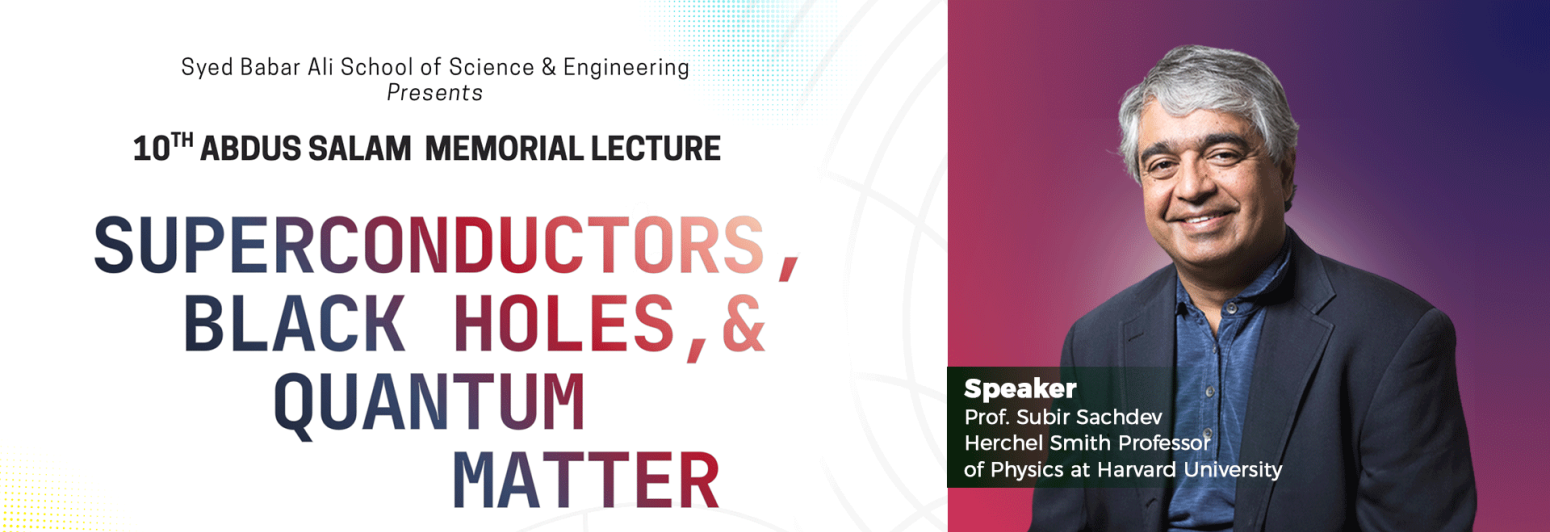
This session will explore how the quantum entanglement of many particles plays a central role in many aspects of modern physics. In the Sachdev-Ye-Kitaev model, complex entanglement leads to a quantum state that does not have any particle-like excitations at all. It will describe how such many-particle systems are helping us understand modern quantum materials, such as high temperature superconductors, as well as the quantum mechanics of black holes.
About the Speaker
Subir Sachdev is the Herchel Smith Professor of Physics at Harvard University. He was born in Delhi, with family roots in the Lahore region. He studied at the Indian Institute of Technology, Delhi, and completed his studies in the United States. He has been elected to national academies of science in India and the United States, and to the Royal Society in the United Kingdom. He is a recipient of several prestigious awards, including the Dirac Medal from the International Centre for Theoretical Physics and the Lars Onsager Prize from the American Physical Society. His research has made extensive contributions to the theory of quantum matter and the understanding of quantum phase transitions.